Home / My Choreographies / September 1969
My first choreography was born accidentally, on a hot summer night when I was trying to fall asleep. The chorus of the song “September” had taken up permanent residence in my mind.
Part B (“Ba-de-ya”)
While imagining the choir singers repeating their “ba-de-ya, say do you remember?” over and over, it occurred to me to design steps following the melody’s rhythmic pattern “1 2 & (pause on 3 4) 5 & 6 & 7 8” to accompany it. The pause felt a bit too long, leaving the dance slightly “incomplete,” so I added a step on count 4:
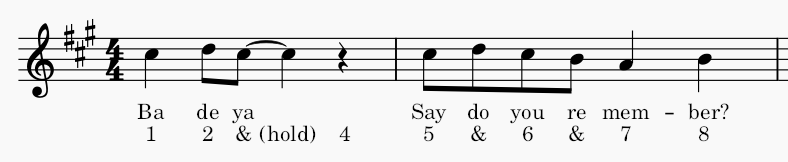
For “5 & 6 &” I had several options, but I decided on “Heel Changes”.
This resulted in Part B1:
B1: R Side, Together, Syncopated Side (“Ba-de-ya”), Hold, Together, R Heel Changes, R Forward, ½ Turn L
Part B2 was meant to accompany another repetition of the same melody, so B2 = B1 felt like a perfect fit.
Part B3 accompanied a slightly different “ba-de-ya”, so I looked for another step for “5 & 6”. A kick-ball-change seemed appropriate.
B3: R Side, Together, Syncopated Back (“Ba-de-ya”), Hold, Touch, L Kick-Ball-Change, L Diagonal Forward, Touch
And that’s how parts B1-3 turned out, nicely synced with the choir melody.
I wasn’t quite sure what to do with part B4, so I left it for later.
Part A = “Sep. ’69”
With the chorus section almost done, I started working on the other part. Thinking about my Beginner level students, I decided to design 32 steps that they could easily dance.
Continuing with the idea of basing steps on musical fragments, I chose the following:
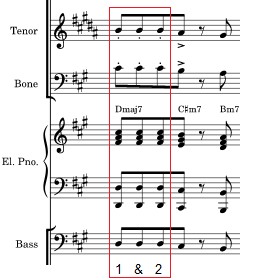
In Part A1, counts 1 & 2 are usually marked by various instruments, which practically calls for a triple step. The clearest example, where many instruments hit together, is this one:
On counts 5-8 at several points in the song, the brass section plays a part that sounded “airy” to me:
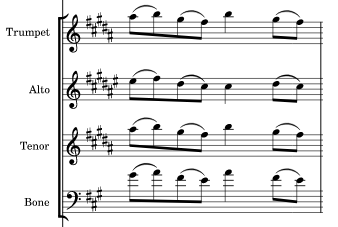
… which suggested the “step, half turn” steps.
And that’s how Part A1 was configured:
A1: Lindi R, 2X { L Forward, ½ Turn R }
The same applied to Part A2, so I did the same thing for the other side:
A2: Lindi L, 2X { R Forward, ½ Turn L }
For Part A3, I couldn’t recall a pattern that clearly repeated, so I filled it with a “rhumba box” with triples. Later I realized that the triples aligned with percussion hits in several moments. A happy coincidence, I suppose!
A3: Rhumba Box with Triples: R Side, Together, Triple Back, L Side, Together, Triple Forward
For Part A4, I decided to highlight the ubiquitous hand claps in the song, which stand out better at that point due to a break in the lead vocals and choir. I also added a quarter turn to make it a 4-wall dance, along with a “scuff” to emphasize several bass and/or drum hits that hit at that exact moment.
A4: 3X { Diagonal Step, Touch with Clap }, Diagonal with ¼ Turn Left, Scuff
In this video, I dance Part A along with a edit of the mentioned musical fragments, combined and highlighted for clarity. So to speak, it’s “the music I dance to” in that part:
I thought making B4 = A4 was a great idea to achieve an effect where, if both choreographies are danced simultaneously as a “floor split” on the same floor, all dancers dance the exact same pattern at some point. In the video “September 1969” vs. “Sep. ’69” I show how both choreographies look when danced together:
I don’t know how other choreographers work, but it’s clear that my musical background drives me to try to harmonize dance steps with aspects of the music, as if they were another instrument in the song. If I keep designing choreographies, I will likely continue along this line. We’ll see.
Note: This has been a simplified explanation of the process. In reality, it took many more iterations of trial and error—I am human, after all!
Why the names “September 1969” and “Sep. ’69”?
It was clear that the choreography needed to be named after the song “September”. To distinguish it from several other choreographies with the same title, I added “1969” for a dear friend who came into the world in that month and year. Yes, I’m a romantic at heart. 🙂
To name the short choreography, I thought it made sense to shorten the name to its abbreviated form: “Sep. ’69”.
Finally, being a patient man, I decided to wait and publish both choreographies on September 21st, which is the date referenced in the song: “Do you remember the 21st night of September…”
That’s all, I think.